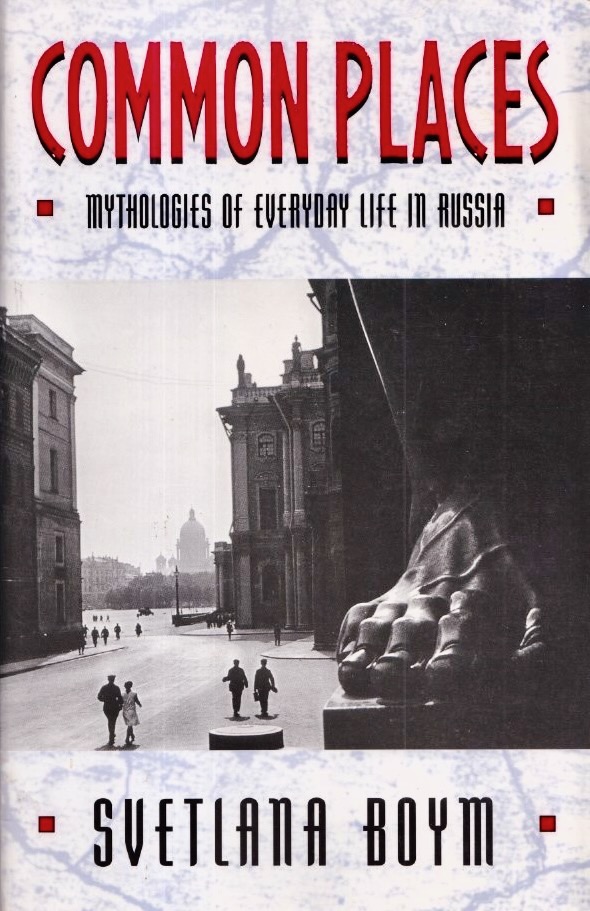
Book 1994

Common Places. Mythologies of Everyday Life in Russia RU

Common Places
Common Places Common Places


Information
Realm
Russian
Author
Svetlana Boym
Title
Common Places
Subtitle
Mythologies of Everyday Life in Russia
Edition
1
Place of Publication
Cambridge, MA
Publisher
Harvard University Press
Date of Publication
1994
Material Type
Book
Format
Paperback
Number of Pages
356
ISBN
674146255
Language
English
Genre
Literary Criticism
Original Price
6.95 $

Svetlana Boym. Common Places: Mythologies of Everyday Life in Russia. Cambridge. Harvard University Press. 1994.

Description

What is the "real Russia"? Why is the relationship between rational dreams and kitsch, between political and artistic utopia and everyday existence so controversial and so difficult to understand? Russian culture, these questions suggest, may be prone to misunderstanding. But all who know the big books of Russian life cross that frontier to get properly inside Russia, to understand a culture.

Boym is a unique guide. A member of the last Soviet generation, she has grown up in Leningrad and has lived in the West for the past eleven years. Her book provides a view of Russia that is historically informed, perceptive, fresh, and detailed, and written with authority. Interweaving analysis with personal accounts of Russian life, Boym conveys the emergences of Russia and examines its peculiar conceptions of private life and privacy, of good and evil, of sincerity and banality. Armed with a dictionary of untranslatable terms, we step around the dark side of the hall structured by a puddle of urine, enter the communal apartment, the central habitat of the book. It is the site of the communal experiment and a focal point of Russian life; a Soviet "common place" and a breeding ground for grassroots movements. Here, privacy is obliterated in the name of collective pressure; here bits of "domestic trash," traces of ideological campaigns for the transformation (perestroika) of everyday life.

Against the Russian and Soviet myths of rational destiny, of triviality, of ordinary, even of utopian dimension, Boym studies Russian notions of the word, language, sentiment, and twentieth-century intellectual thought for an all too popular culture. With her eye to Moscow and Leningrad, eavesdropping on domestic life, on dissident jokes, films, and TV programs, Boym traces the 1991 coup that marked the end of the Soviet experiment and of perestroika. She ends with a poignant reflection on the nature of communal utopia and nostalgia, on homelessness and the sadness of being home.